
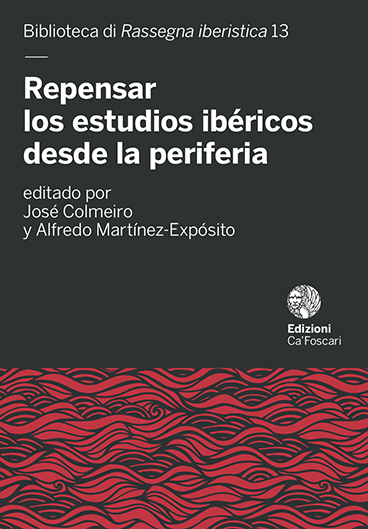
| Title | Rethinking Iberian Studies from the Periphery |
|---|---|
| Contributor | José Colmeiro (editor) |
| Alfredo Martínez-Expósito(opens in new tab)(editor) | |
| DOI | https://doi.org/10.30687/978-88-6969-302-1(opens in new tab) |
| Landing page | https://edizionicafoscari.it/en/edizioni4/libri/978-88-6969-303-8/(opens in new tab) |
| License | https://creativecommons.org/licenses/by/4.0/(opens in new tab) |
| Copyright | José Colmeiro, Alfredo Martínez-Expósito |
| Publisher | Edizioni Ca’ Foscari – Venice University Press |
| Publication place | Venice, Italy |
| Published on | 2019-02-04 |
| Series |
|
| ISBN | 978-88-6969-302-1 (PDF) |
| Short abstract | This volume is an attempt to renew and de-differentiate Iberian studies, focusing on the peripheral as a geographical, cultural and ideological positioning, in order to question the hegemonic optic of the centre and review the pre-existing cultural canons, and their gaps, exclusions and invisibilities. It is a multiple task - carried out from Australia and New Zealand - that includes the study of peripheral cultural forms, both of the so-called historical nationalities absent from the Spanish cultural/literary/linguistic canon, and of other minority groups that have traditionally been displaced to different types of periphery, such as exiles, political prisoners, immigrants, gitanos, the working classes, colonial subjects or sexual minorities, in a global context. |
| Long abstract | This volume is an attempt to renew and de-differentiate Iberian studies, focusing on the peripheral as a geographical, cultural and ideological positioning, in order to question the hegemonic optic of the centre and review the pre-existing cultural canons, and their gaps, exclusions and invisibilities. It is a multiple task - carried out from Australia and New Zealand - that includes the study of peripheral cultural forms, both of the so-called historical nationalities absent from the Spanish cultural/literary/linguistic canon, and of other minority groups that have traditionally been displaced to different types of periphery, such as exiles, political prisoners, immigrants, gitanos, the working classes, colonial subjects or sexual minorities, in a global context. |
| Language | Italian (Original) |
| THEMA |
|
| BISAC |
|
| Keywords |
|