
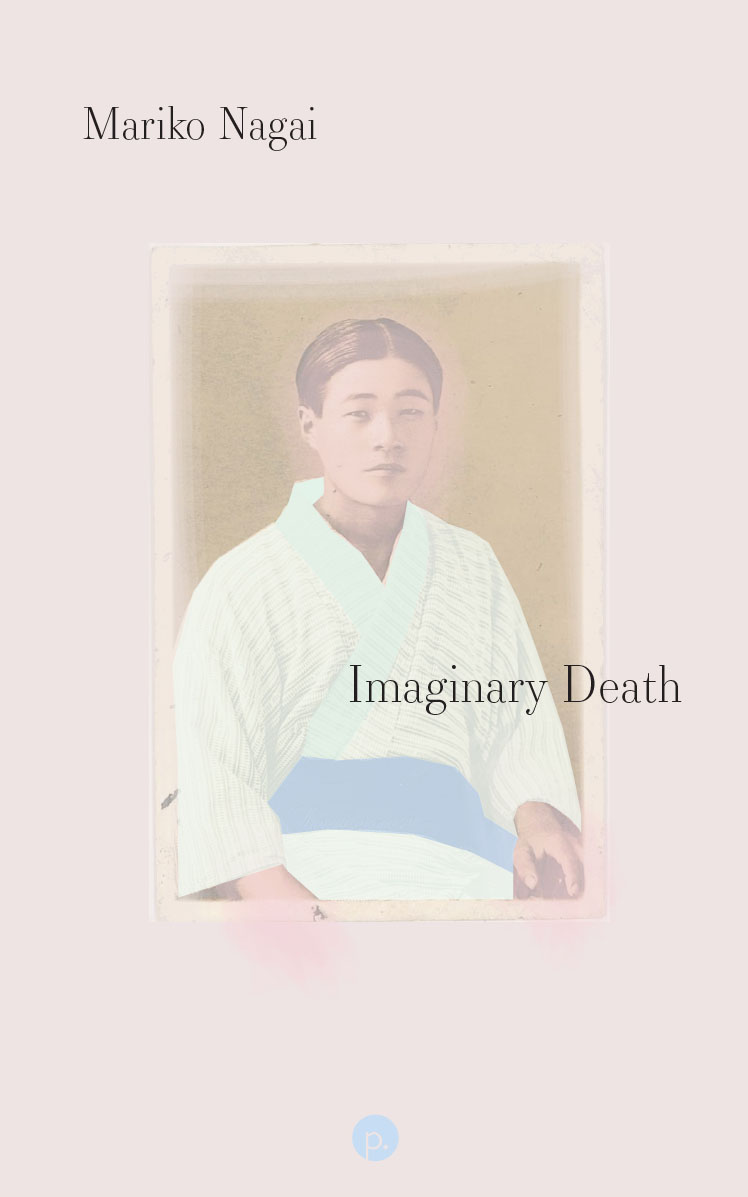
| Title | Imaginary Death |
|---|---|
| Contributor | Mariko Nagai (author) |
| DOI | https://doi.org/10.53288/0531.1.00(opens in new tab) |
| Landing page | https://punctumbooks.com/titles/imaginary-death/(opens in new tab) |
| License | https://creativecommons.org/licenses/by-nc-sa/4.0/(opens in new tab) |
| Copyright | Mariko Nagai |
| Publisher | punctum books |
| Publication place | Earth, Milky Way |
| Published on | 2025-09-26 |
| ISBN | 978-1-68571-236-5 (Paperback) |
| 978-1-68571-237-2 (PDF) | |
| Long abstract | A man dies. He dies because he must—because without his death, there is no story, and, in the end, no history itself. So begins Mariko Nagai’s* Imaginary Death,* a creative nonfiction book that examines how the author’s grandfather, an ordinary man born in a small village in the early 20th century, is unmade and remade into a perfect Japanese Imperial Soldier by the era he was born into. In the kaleidoscope composed of archival documents, letters, journals, research, interviews, and photographs,* Imaginary Death* traces the life of a man who fought and died for the empire, whose death, obscured by lack of documentation, must be composited of many possible ways men could die in Papua New Guinea. Only forty out of four thousand men from the regimental unit survived by the end of the repatriation in 1946: his was one small death out of many. In the tradition of James Agee and Walker Evans’s seminal work on the Great Depression Let Us Now Praise Famous Men, Imaginary Death is a work that is part meditation, part history, and part fragments of memory that tell a story of a Japanese soldier’s life and death during World War II. Ultimately, Imaginary Death is a textual landscape of imagination, fact, history, and dreams all intersecting to create a psychological terrain that is not limited in the same way as history or nonfiction books, but is rather a new imaginative cartography, no less real than history itself. |
| Print length | 302 pages |
| Language | English (Original) |
| Dimensions | 127 x 18 x 203 mm | 5" x 0.69" x 8" (Paperback) |
| Weight | 400g | 14.10oz (Paperback) |
| LCCN | 2025942579 |
| THEMA |
|
| BISAC |
|
| Keywords |
|
Contributors
Mariko Nagai
(author)Born in Tokyo and raised in Europe and the US, Mariko Nagai received a MA in Creative Writing (Poetry) at New York University. Her numerous honors include the Erich Maria Remarque Fellowship from NYU, fellowships from the Rockefeller Foundation’s Bellagio Center, UNESCO-Ashberg Bursaries for the Arts, Yaddo, Djerassi, and Akademie Schloss Solitude, amongst others. She has received the prestigious Pushcart Prizes both in poetry and fiction. Her books include Histories of Bodies: Poems (Red Hen Press, 2007), Georgic: Stories (BkMk Press, 2010), Dust of Eden: a Novel (Albert Whitman, 2014), Irradiated Cities (Les Figues/punctum, 2017/2022), Under the Broken Sky: a Novel (Henry Holt, 2017), and others. She is Professor of Creative Writing and Japanese literature at Temple University, Tokyo, Japan campus.