
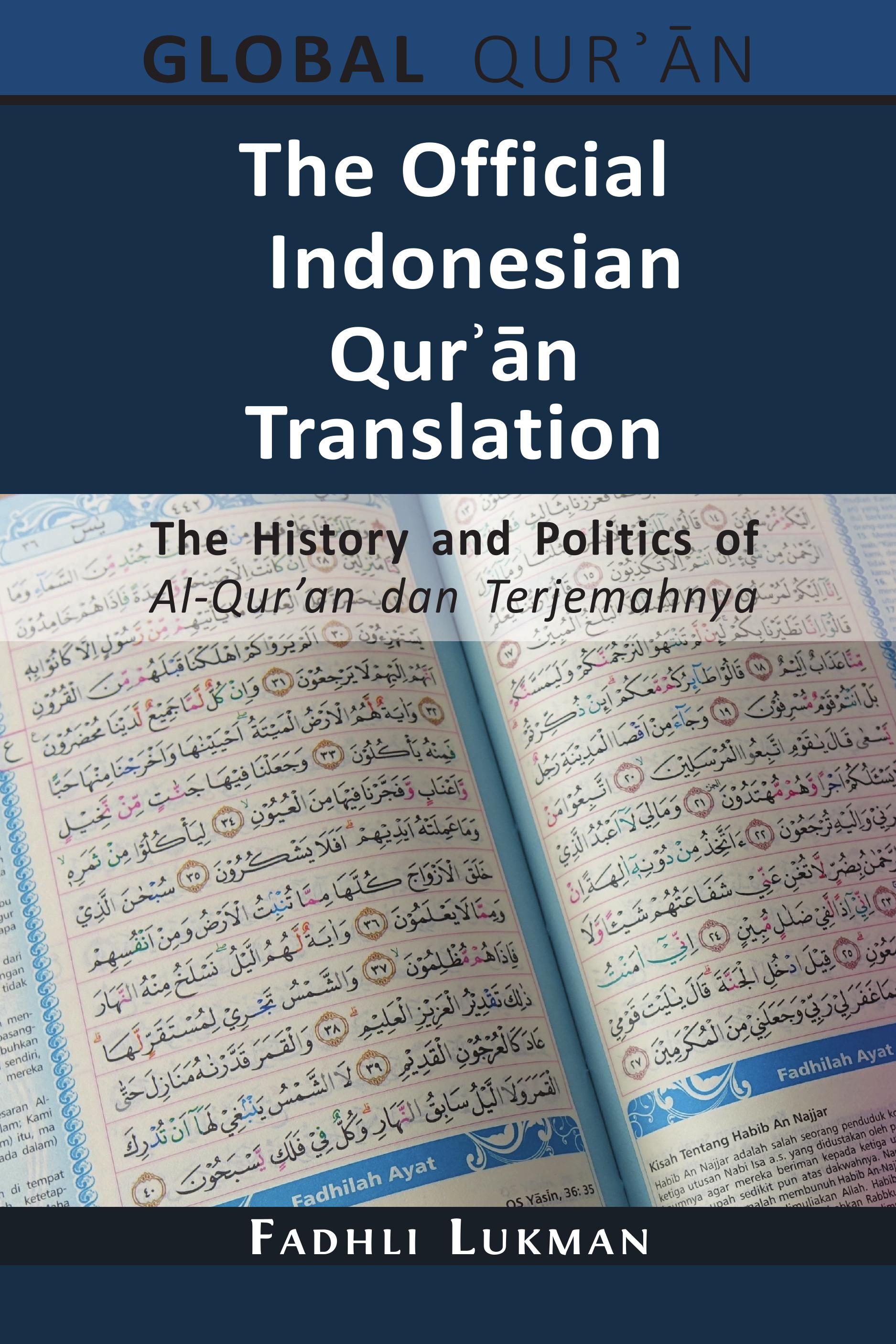
| Title | The Official Indonesian Qurʾān Translation |
|---|---|
| Subtitle | The History and Politics of Al-Qur’an dan Terjemahnya |
| Contributor | Fadhli Lukman(opens in new tab)(author) |
| DOI | https://doi.org/10.11647/OBP.0289(opens in new tab) |
| Landing page | https://www.openbookpublishers.com/books/10.11647/obp.0289(opens in new tab) |
| License | https://creativecommons.org/licenses/by/4.0/(opens in new tab) |
| Copyright | Fadhli Lukman; |
| Publisher | Open Book Publishers |
| Publication place | Cambridge, UK |
| Published on | 2022-10-06 |
| Series |
|
| ISBN | 978-1-80064-398-7 (Paperback) |
| 978-1-80064-399-4 (Hardback) | |
| 978-1-80064-400-7 (PDF) | |
| 978-1-80064-922-4 (HTML) | |
| 978-1-80064-403-8 (XML) | |
| 978-1-80064-401-4 (EPUB) | |
| 978-1-80064-402-1 (AZW3) | |
| Short abstract | This book studies the political and institutional project of Al-Qur’an dan Terjemahnya, the official translation of the Qurʾān into Indonesian by the Indonesian government. It investigates how the translation was produced and presented, and how it is read, as well as considering the implications of the state’s involvement in such a work. |
| Long abstract | This book studies the political and institutional project of Al-Qur’an dan Terjemahnya, the official translation of the Qurʾān into Indonesian by the Indonesian government. It investigates how the translation was produced and presented, and how it is read, as well as considering the implications of the state’s involvement in such a work. Lukman analyses the politicisation of the Qurʾān commentary through discussion of how the tafsīr mechanism functions in this version, weighing up the translation’s dual constraints: the growing political context, on the one hand, and the tafsīr tradition on the other. In doing so, the book pays attention to three key areas: the production phase, the textual material, and the reception of the translation by readers. This book will be of value to scholars with an interest in tafsīr studies, modern and Southeast Asian or Indonesian tafsīr sub-fields, the study of Qurʾān translations, and Indonesian politics and religion more broadly. |
| Print length | 366 pages (xx+346) |
| Language | English (Original) |
| Dimensions | 156 x 25 x 234 mm | 6.14" x 0.98" x 9.21" (Paperback) |
| 156 x 28 x 234 mm | 6.14" x 1.10" x 9.21" (Hardback) | |
| Weight | 690g | 24.34oz (Paperback) |
| 869g | 30.65oz (Hardback) | |
| Media | 3 illustrations |
| OCLC Number | 1348487055 |
| LCCN | 2021385337 |
| BIC |
|
| BISAC |
|
| LCC |
|
| Keywords |
|
Contents
- Fadhli Lukman
- Islam and Muslims in the State of Indonesia: A Brief Overview
- Fadhli Lukman
- An Introduction to Al-Qur’an dan Terjemahnya
- Fadhli Lukman
- The Political Significance of Al-Qur’an dan Terjemahnya
- Fadhli Lukman
- The Hermeneutical Production
- Fadhli Lukman
- Between Official Translation and the Official Reform
- Fadhli Lukman
- The Official Translation and Ideological Vocabulary of the State
- Fadhli Lukman
- One Translation, Two Faces: The Ambivalent Authority of the Official Qur’an Translation
- Fadhli Lukman
- Fadhli Lukman
Contributors
Fadhli Lukman
(author)Fadhli Lukman is a faculty member at the Department of Qurʾānic Studies (Ilmu Al-Qur'an dan Tafsir) of Universitas Islam Negeri Sunan Kalijaga Yogyakarta, Indonesia. He is also an associate researcher at Laboratorium Studi Qur'an-Hadis (LSQH). He completed his basic Islamic disciplines in Madrasah Sumatera Thawalib Parabek, continued his Bachelor's and Master's studies in Qurʾān and Tafsīr studies at Universitas Islam Negeri Sunan Kalijaga Yogyakarta, and then completed his Ph.D at the Department of Islamic Studies, Orientalisches Seminar, Albert-Ludwigs-Universität Freiburg in 2019. His work mainly deals with Qurʾānic hermeneutics and the history of tafsīr in Indonesia.