
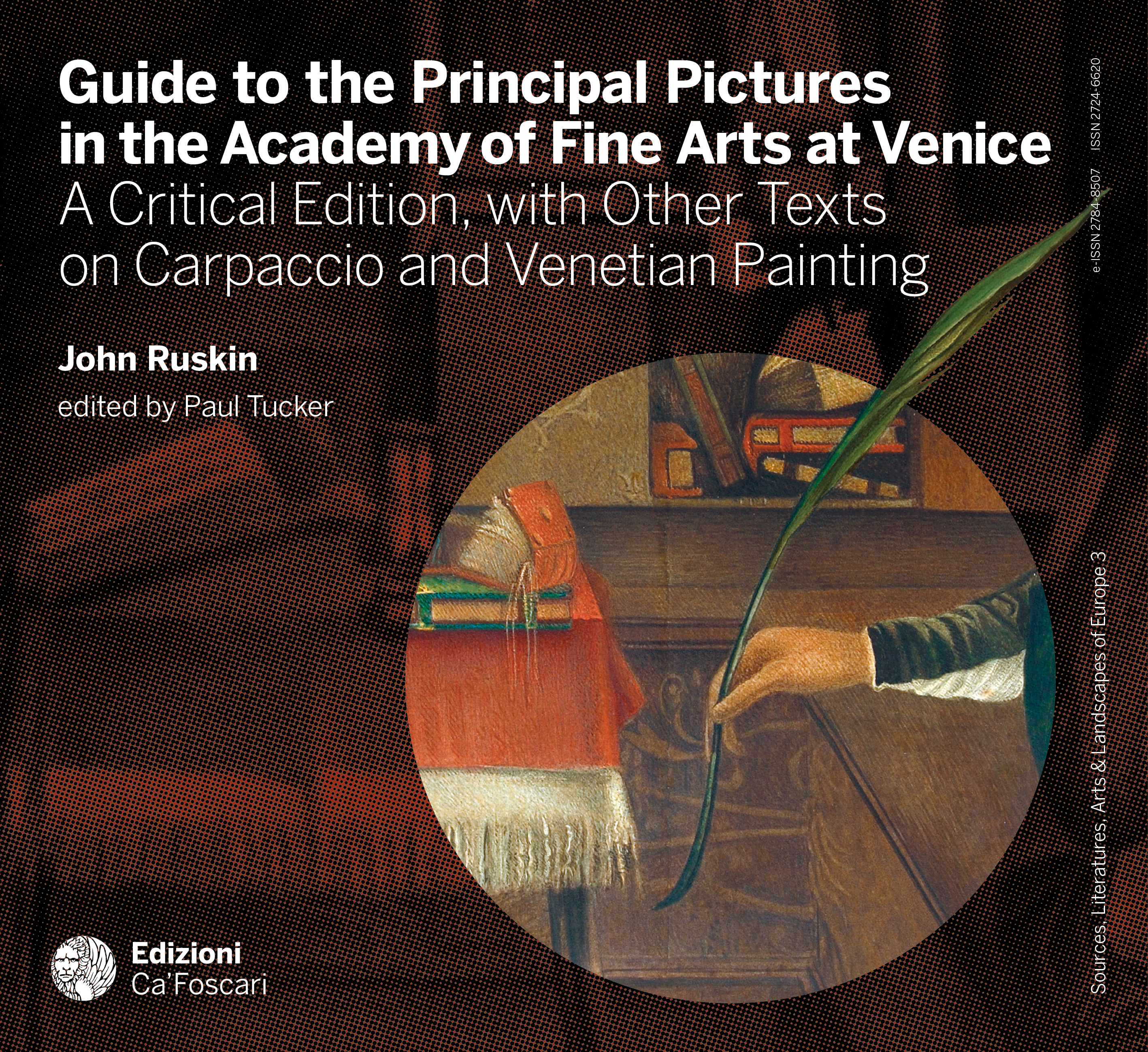
| Title | Guide to the Principal Pictures in the Academy of Fine Arts at Venice |
|---|---|
| Subtitle | A Critical Edition, with Other Texts on Carpaccio and Venetian Painting |
| Contributor | John Ruskin (author) |
| Paul Tucker (editor) | |
| DOI | https://doi.org/10.30687/978-88-6969-712-8(opens in new tab) |
| Landing page | https://edizionicafoscari.it/en/edizioni4/libri/978-88-6969-713-5/(opens in new tab) |
| License | https://creativecommons.org/licenses/by/4.0/(opens in new tab) |
| Copyright | Paul Tucker, John Ruskin |
| Publisher | Edizioni Ca’ Foscari – Venice University Press |
| Publication place | Venice, Italy |
| Published on | 2023-04-18 |
| Series |
|
| ISBN | 978-88-6969-712-8 (Paperback) |
| 978-88-6969-712-8 (PDF) | |
| Short abstract | “In the first place, if the weather is fine, go outside the gate you have just come in at, and look above it”. From its opening words any of the “English travellers” for whom it was expressly written in 1877 might have surmised that this Guide to Venice’s main picture gallery would not conform to type. Ruskin himself thought of it as an “explosive torpedo” aiming to subvert received notions not just of the modern guidebook as a genre but of the culture of travel it served, of the purpose of museums, of his own reputation as an interpreter of Venetian art and history and, more broadly still, of the very nature of art and its history. The Guide’s idiosyncrasies have often been dismissed as signs of personal irritation and obsession, even of mental instability. This new and fully critical edition re-examines the circumstances of its composition and its special relation to Ruskin’s mature appraisal of the painting of Carpaccio as a signal example, even in its ambiguities, of the “sacred imagination of things that are not”. It also explores the Guide’s intertextual links with Ruskin’s other writings of the period (a selection of which are included as “Supplementary Texts”), with the aim of showing it to have been integral to the drive to moral, social and aesthetic reform generally informing his still neglected late work. |
| Long abstract | “In the first place, if the weather is fine, go outside the gate you have just come in at, and look above it”. From its opening words any of the “English travellers” for whom it was expressly written in 1877 might have surmised that this Guide to Venice’s main picture gallery would not conform to type. Ruskin himself thought of it as an “explosive torpedo” aiming to subvert received notions not just of the modern guidebook as a genre but of the culture of travel it served, of the purpose of museums, of his own reputation as an interpreter of Venetian art and history and, more broadly still, of the very nature of art and its history. The Guide’s idiosyncrasies have often been dismissed as signs of personal irritation and obsession, even of mental instability. This new and fully critical edition re-examines the circumstances of its composition and its special relation to Ruskin’s mature appraisal of the painting of Carpaccio as a signal example, even in its ambiguities, of the “sacred imagination of things that are not”. It also explores the Guide’s intertextual links with Ruskin’s other writings of the period (a selection of which are included as “Supplementary Texts”), with the aim of showing it to have been integral to the drive to moral, social and aesthetic reform generally informing his still neglected late work. |
| Print length | 194 pages |
| Language | Italian (Original) |
| THEMA |
|
| BISAC |
|
| Keywords |
|