
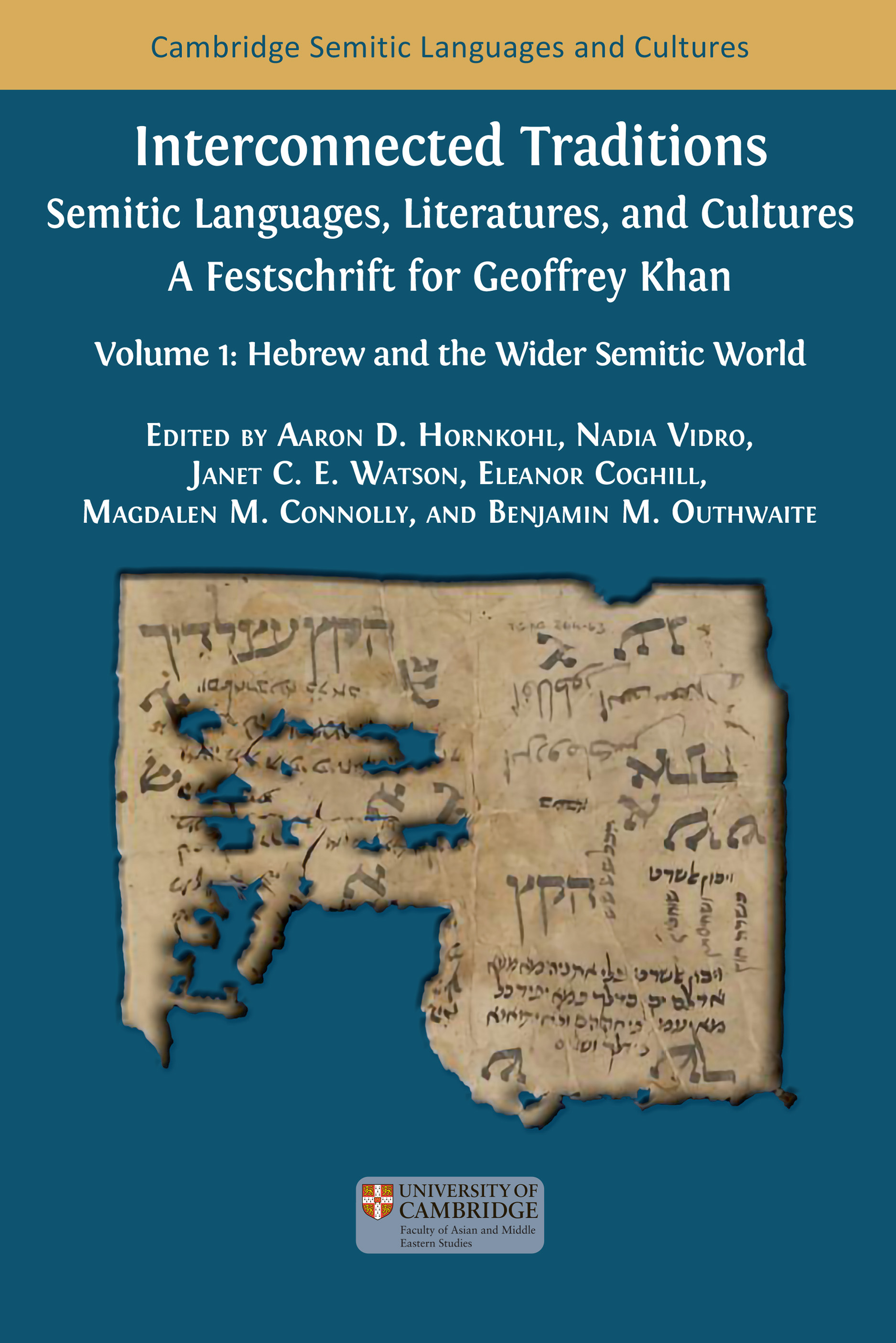
| Title | Interconnected Traditions: Semitic Languages, Literatures, Cultures—A Festschrift for Geoffrey Khan |
|---|---|
| Subtitle | Volume 1: Hebrew and the Wider Semitic World |
| Contributor | Aaron D. Hornkohl(opens in new tab)(editor) |
| Nadia Vidro (editor) | |
| Janet C.E. Watson(opens in new tab)(editor) | |
| Eleanor Coghill (editor) | |
| Magdalen M. Connolly (editor) | |
| Benjamin M. Outhwaite(opens in new tab)(editor) | |
| DOI | https://doi.org/10.11647/OBP.0463(opens in new tab) |
| Landing page | https://www.openbookpublishers.com/books/10.11647/OBP.0463(opens in new tab) |
| License | https://creativecommons.org/licenses/by-nc/4.0/(opens in new tab) |
| Copyright | Aaron D. Hornkohl; Nadia Vidro; Janet C. E. Watson; Eleanor Coghill; Magdalen M. Connolly; Benjamin M. Outhwaite. Copyright of individual chapters are maintained by the chapter author(s). |
| Publisher | Open Book Publishers |
| Publication place | Cambridge, UK |
| Published on | 2025-03-07 |
| Book set | This book is part of a 2-volume set. The other volume in the set is: |
| ISBN | 978-1-80511-576-2 (Paperback) |
| 978-1-80511-577-9 (Hardback) | |
| 978-1-80511-578-6 (PDF) | |
| Short abstract | Geoffrey Khan’s pioneering scholarship has transformed the study of Semitic languages, literatures, and cultures, leaving an indelible mark on fields ranging from Biblical Hebrew and Aramaic dialectology to medieval manuscript traditions and linguistic typology. This Festschrift, celebrating a distinguished career that culminated in his tenure (2012–2025) as Regius Professor of Hebrew in the Faculty of Asian and Middle Eastern Studies at the University of Cambridge, brings together contributions from a vast and representative array of scholars—retired, established, and up and coming—whose work has been influenced by his vast intellectual legacy. |
| Long abstract | Geoffrey Khan’s pioneering scholarship has transformed the study of Semitic languages, literatures, and cultures, leaving an indelible mark on fields ranging from Biblical Hebrew and Aramaic dialectology to medieval manuscript traditions and linguistic typology. This Festschrift, celebrating a distinguished career that culminated in his tenure (2012–2025) as Regius Professor of Hebrew in the Faculty of Asian and Middle Eastern Studies at the University of Cambridge, brings together contributions from a vast and representative array of scholars—retired, established, and up and coming—whose work has been influenced by his vast intellectual legacy. Reflecting the interconnected traditions that Khan has illuminated throughout his career, this volume presents cutting-edge research on Hebrew and Aramaic linguistics, historical syntax, manuscript studies, and the transmission of textual traditions across centuries and cultures. Contributors engage with topics central to Khan’s scholarship, including the evolution of the Biblical Hebrew verbal system, the intricacies of Masoretic notation, Geniza discoveries, Samaritan and medieval Judaeo-Arabic texts, and computational approaches to linguistic analysis. As Khan retires from his role as Regius Professor, this collection stands as both a tribute and a continuation of his work, honouring his lifelong dedication to understanding and preserving the linguistic and literary heritage of the Semitic world. The content of this book has been updated. |
| Print length | 960 pages (2+xxxii+926) |
| Language | English (Original) |
| Dimensions | 156 x 47 x 234 mm | 6.14" x 1.85" x 9.21" (Paperback) |
| 156 x 49 x 234 mm | 6.14" x 1.93" x 9.21" (Hardback) | |
| Weight | 1290g | 45.50oz (Paperback) |
| 1481g | 52.24oz (Hardback) | |
| OCLC Number | 1506476236 |
| THEMA |
|
| BISAC |
|
| Keywords |
|
Contents
- Aaron D. Hornkohl
- Bo Isaksson
- Aaron D. Hornkohl
- Christo van der Merwe
- Robert S. D. Crellin
- Ambjörn Sjörs
- Benjamin Paul Kantor
- Elizabeth Robar
- Gary A. Rendsburg
- Cynthia L. Miller-Naudé
- Jacobus A. Naudé
- Adina Moshavi
- Ethan Jones
- Noam Mizrahi
- Moshe Florentin
- Edward Cook
- Mila Neishtadt
- Yehudit Henshke
- Yaron Peleg
- Aaron J. Koller
- Tania Notarius
- Lutz Edzard
- Simon Hopkins
- Benjamin D. Suchard
- Na‘ama Pat-El
- Janet C.E. Watson
- Clive Holes
- Leonid Kogan
- Maria Bulakh
- Holger Gzella
- John Healey
- Matthew Morgenstern
- Tom Alfia
- Johan Lundberg
- Ivri Bunis
- Victor Golinets
Contributors
Aaron D. Hornkohl
(editor)Aaron D. Hornkohl (PhD, The Hebrew University of Jerusalem, 2012) is Associate Professor in Hebrew, Faculty of Asian and Middle Eastern Studies, University of Cambridge. His research focuses on ancient Hebrew philology and linguistics, especially historical linguistics and ancient Hebrew diachrony; the components of the standard Tiberian Masoretic biblical tradition; and that tradition’s profile in the context of other biblical traditions and extrabiblical sources. Most recent publications: The Historical Depth of the Tiberian Reading Tradition (University of Cambridge Faculty of Asian and Middle Eastern Studies and Open Book Publishers, 2023); Diachronic Diversity in Classical Biblical Hebrew (University of Cambridge Faculty of Asian and Middle Eastern Studies and Open Book Publishers, 2024).
Nadia Vidro
(editor)Nadia Vidro (PhD, University of Cambridge) is a Senior Research Fellow in the Department of Hebrew and Jewish Studies, UCL, and an Editorial Fellow in the Invisible East programme, Oxford. Dr Vidro’s primary research interests are Hebrew manuscripts and Jewish intellectual history. Her research at UCL focuses on the history of the Jewish calendar. An additional research interest is the history of grammar, including the Karaite tradition of Biblical Hebrew grammar and the transmission of grammatical knowledge between the Jewish and the Muslim cultures. Her monographs include Verbal Morphology in the Karaite Treatise on Hebrew Grammar Kitab al-ʿUqūd fi Taṣārīf al-Luġa al-ʿIbrāniyya (Brill, 2011), A Medieval Karaite Pedagogical Grammar of Hebrew: A Critical Edition and English Translation of Kitab al-ʿUqūd fi Taṣārīf al-Luġa al-ʿIbrāniyya (Brill, 2013), and Saadya Gaon’s Works on the Jewish Calendar: A Study with Five Critical Editions (Brill, forthcoming).
Janet C.E. Watson
(editor)Janet C. E. Watson (PhD, SOAS) has worked at the Universities of Edinburgh, Durham, and Salford and has held visiting posts at the Universities of Heidelberg (2003–2004) and Oslo (2004–2005). She took up the Leadership Chair for Language at the University of Leeds in 2013 and was that same year elected Fellow of the British Academy. Since 2019, she has directed the Centre for Endangered Languages, Cultures and Ecosystems (CELCE). She is currently an Honorary Professor at the University of St Andrews and a Visiting Professor at Sultan Qaboos University. Her current research areas focus on Modern South Arabian and the language–nature relationship.
Eleanor Coghill
(editor)Eleanor Coghill (PhD, University of Cambridge) is Professor in Semitic Languages in the Department of Linguistics and Philology, University of Uppsala. Her work has focused on Aramaic, especially the North-Eastern Neo-Aramaic varieties, whose highly endangered status makes documentation a priority. Her research also has a diachronic focus, looking at the development of Aramaic, in particular the effects of language contact. She is also interested in the Arabic dialects of the same region. Among her publications are The Rise and Fall of Ergativity in Aramaic: Cycles of Alignment Change (Oxford University Press, 2016) and ‘Northeastern Neo-Aramaic and language contact’, in (Anthony Grant, ed.) The Oxford Handbook of Language Contact (Oxford University Press 2020).
Magdalen M. Connolly
(editor)Magdalen M. Connolly (PhD, University of Cambridge) was most recently Humboldt Postdoctoral Research Fellow, Institut für den Nahen und Mittleren Osten, Ludwig-Maximilians-Universität (LMU), Munich, after having completed a Leverhulme Early Career Fellow, Faculty of Asian and Middle Eastern Studies, University of Cambridge. Her areas of interest are Arabic, Judaeo-Arabic, historical linguistics, the Cairo Geniza collections, codicology and palaeography of manuscripts, with a special focus on ‘non-standard’ Arabic writing. Among her publications are ‘Splitting Definitives: The Separation of the Definite Article in Medieval and Pre-Modern Written Judeo-Arabic’, Journal of Jewish Languages 9/1 (2021), (with Nick Posegay) ‘A Survey of Personal-Use Qur’an Manuscripts Based on Fragments from the Cairo Genizah’, Journal of Qur’anic Studies 23/2 (2021), and (with Nick Posegay and Ben Outhwaite) From the Battlefield of Books: Essays Celebrating 50 Years of the Taylor-Schechter Genizah Research Unit (Brill, 2024).
Benjamin M. Outhwaite
(editor)Ben Outhwaite (PhD, University of Cambridge) has been Head of the Genizah Research Unit in the Cambridge University Library since 2006, where he has the responsibility of running a research team dedicated to the world’s largest and most important single collection of medieval Jewish manuscripts, the Taylor-Schechter Cairo Genizah Collection. His current research interests revolve around Hebrew and its use and transmission in the Middle Ages: the vocalisation traditions of Biblical (and post-biblical) Hebrew, the Medieval Hebrew language (particularly its use as a medium of communication throughout the early Middle Ages), Arabic and Judaeo-Arabic poetry manuscripts in the Cairo Genizah, and the documentary history of the communities who deposited manuscripts there. Recent publications include ‘The Curious Case of the Corresponding Colophons in Codex Cairo 3’, in Linguistic and Philological Studies of the Hebrew Bible and its Manuscripts (Brill, 2023), and ‘Water and Prices: A View of the Nile from the Cairo Genizah’, in The Nile Delta: Histories from Antiquity to the Modern Period (Cambridge University Press, 2024).