
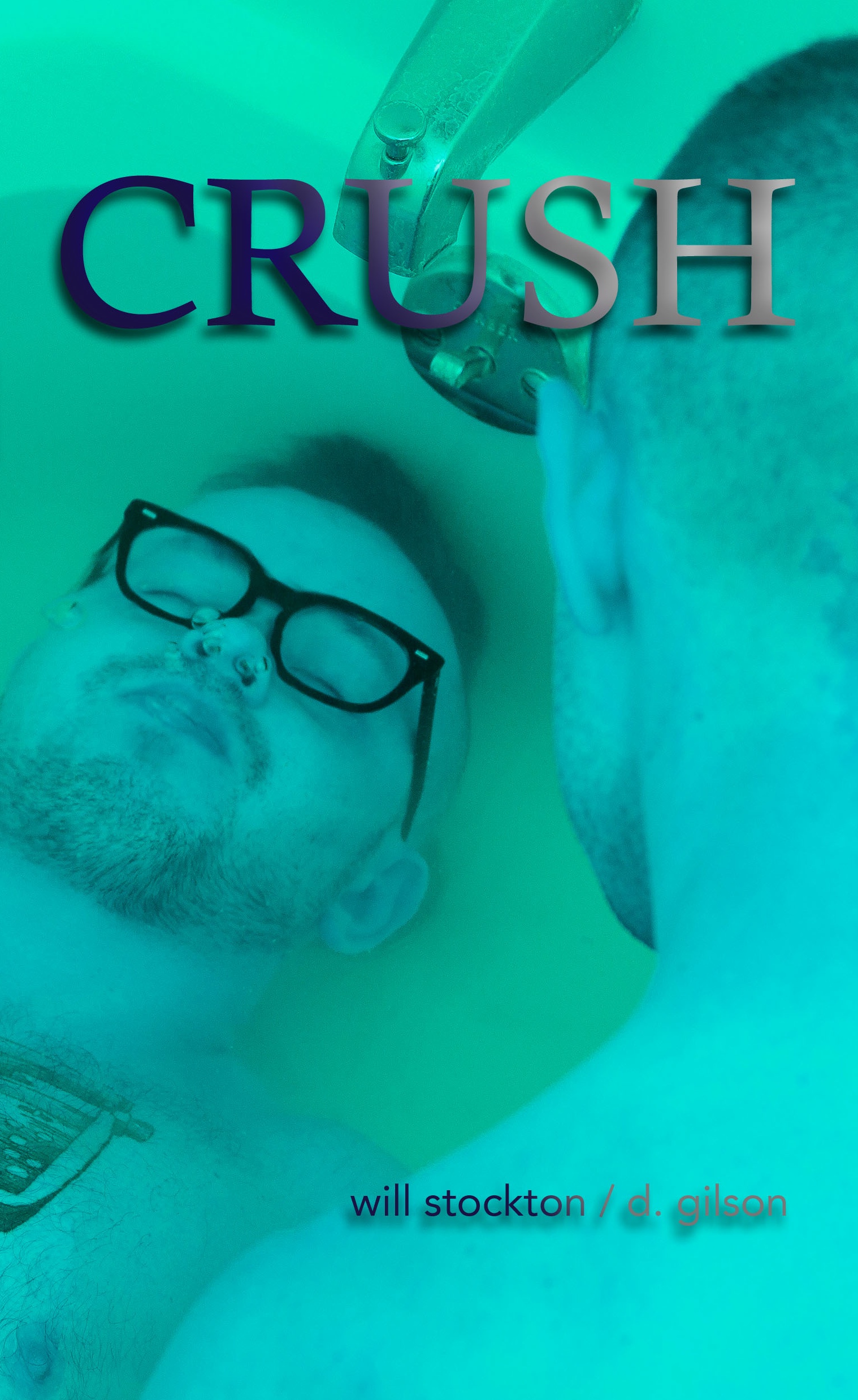
| Title | Crush |
|---|---|
| Contributor | Will Stockton (author) |
| D. Gilson (author) | |
| DOI | https://doi.org/10.21983/P3.0063.1.00(opens in new tab) |
| Landing page | https://punctumbooks.com/titles/crush/(opens in new tab) |
| License | https://creativecommons.org/licenses/by-nc-sa/3.0/(opens in new tab) |
| Copyright | Stockton, Will; Gilson, D. |
| Publisher | punctum books |
| Publication place | Brooklyn, NY |
| Published on | 2014-02-27 |
| ISBN | 978-0-615-97895-6 (Paperback) |
| Long abstract | In Crush, a stunning collection of erotic poems and queer meditations delineating Stockton’ and Gilson’s mutual crushing on each other, but also all of the ways in which, sweetly and also sadly, affection ameliorates the anguishes that, despite our deepest devotions, are never constant, Stockton and Gilson write, In Aranye Fradenburg’s words, Shakespeare’s sonnets describe “the love you feel for inappropriate objects: for someone thirty years older, thirty years younger. The kind of love that makes a fool, a pervert, a stalker out of you.” Let’s start here, for much of this description applies to Petrarchan conventions as well. Let’s start here, with this affective entrance into the poems and the impossibility of dispossessing the other’s voice in the manufacture of one’s own machine. Let’s start here, with a vision of poems as indexes of crushes rendered inappropriate, unhealthy by some gradation of difference and level of intensity. With the question of what distinguishes a crush from love if both turn you into a different self. Under oak trees and sunlight, in coffee shops and locker rooms, steam rooms and seminar rooms, and in conversation with Milton, Shakespeare, Frank O’Hara, Narcissus, Allen Ginsberg, Jacques Derrida, Aranye Fradenburg, Mary Magdalene, Freud, Oscar Wilde, José Esteban Muñoz, Eve Kosofsky Sedgwick, Elton John, and Prince, among other poets, harlots, saints, and scholars, Stockton and Gilson explore the ways in which friendship, desire, falling, swerving, possession, holding, faggoting, falling, longing, poeming, and crushing open the self to queerly utopic, if also difficult, deflections — other, more improbable modes of being, as Foucault might have said. |
| Print length | 120 pages |
| Language | English (Original) |
| Dimensions | 127 x 203 mm | 5" x 8" (Paperback) |
| THEMA |
|
| BIC |
|
| BISAC |
|
| Keywords |
|
Contributors
Will Stockton
(author)Will Stockton is Associate Professor of English at Clemson University. He has written a lot about about how people in the Renaissance had sex. D. Gilson is a PhD candidate in English at The George Washington University. He has written a lot about how hipsters have sex and are always disappointed.