
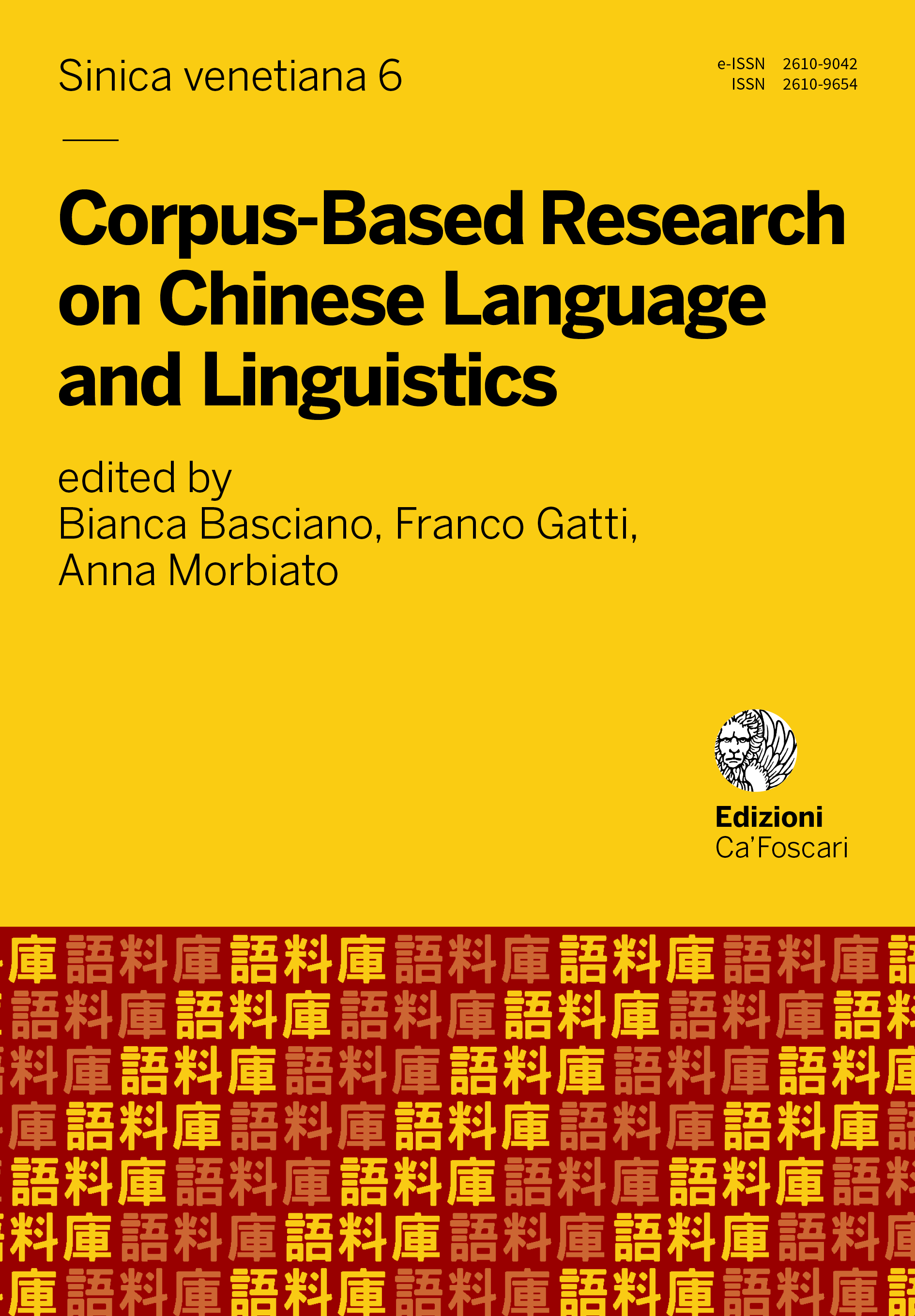
| Title | Corpus-Based Research on Chinese Language and Linguistics |
|---|---|
| Contributor | Bianca Basciano(opens in new tab)(editor) |
| Franco Gatti(opens in new tab)(editor) | |
| Anna Morbiato(opens in new tab)(editor) | |
| DOI | https://doi.org/10.30687/978-88-6969-406-6(opens in new tab) |
| Landing page | https://edizionicafoscari.it/en/edizioni4/libri/978-88-6969-407-3/(opens in new tab) |
| License | https://creativecommons.org/licenses/by/4.0/(opens in new tab) |
| Copyright | Bianca Basciano, Anna Morbiato, Franco Gatti |
| Publisher | Edizioni Ca’ Foscari – Venice University Press |
| Publication place | Venice, Italy |
| Published on | 2020-12-21 |
| Series |
|
| ISBN | 978-88-6969-406-6 (Paperback) |
| 978-88-6969-406-6 (PDF) | |
| Short abstract | This volume collects papers presenting corpus-based research on Chinese language and linguistics, from both a synchronic and a diachronic perspective. The contributions cover different fields of linguistics, including syntax and pragmatics, semantics, morphology and the lexicon, sociolinguistics, and corpus building. There is now considerable emphasis on the reliability of linguistic data: the studies presented here are all grounded in the tenet that corpora, intended as collections of naturally occurring texts produced by a variety of speakers/writers, provide a more robust, statistically significant foundation for linguistic analysis. The volume explores not only the potential of using corpora as tools allowing access to authentic language material, but also the challenges involved in corpus interrogation, analysis, and building. |
| Long abstract | This volume collects papers presenting corpus-based research on Chinese language and linguistics, from both a synchronic and a diachronic perspective. The contributions cover different fields of linguistics, including syntax and pragmatics, semantics, morphology and the lexicon, sociolinguistics, and corpus building. There is now considerable emphasis on the reliability of linguistic data: the studies presented here are all grounded in the tenet that corpora, intended as collections of naturally occurring texts produced by a variety of speakers/writers, provide a more robust, statistically significant foundation for linguistic analysis. The volume explores not only the potential of using corpora as tools allowing access to authentic language material, but also the challenges involved in corpus interrogation, analysis, and building. |
| Print length | 364 pages |
| Language | Italian (Original) |
| THEMA |
|
| BISAC |
|
| Keywords |
|