
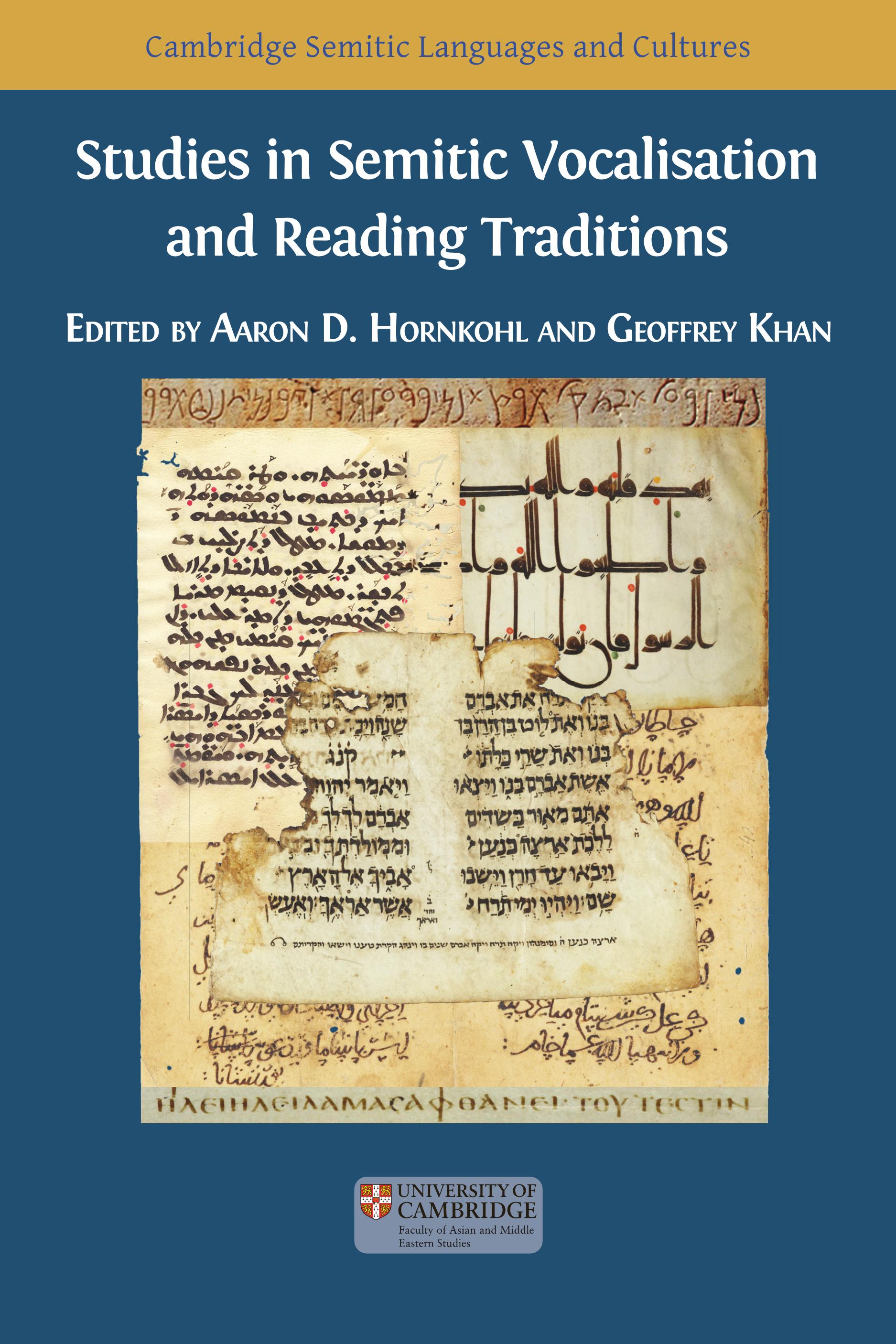
| Title | Studies in Semitic Vocalisation and Reading Traditions |
|---|---|
| Contributor | Aaron D. Hornkohl(opens in new tab)(editor) |
| Geoffrey Khan(opens in new tab)(editor) | |
| DOI | https://doi.org/10.11647/OBP.0207(opens in new tab) |
| Landing page | https://www.openbookpublishers.com/books/10.11647/obp.0207(opens in new tab) |
| License | http://creativecommons.org/licenses/by/4.0/(opens in new tab) |
| Copyright | Aaron Hornkohl; Geoffrey Khan |
| Publisher | Open Book Publishers |
| Publication place | Cambridge, UK |
| Published on | 2020-06-01 |
| Series |
|
| ISBN | 978-1-78374-935-5 (Paperback) |
| 978-1-78374-936-2 (Hardback) | |
| 978-1-78374-937-9 (PDF) | |
| Short abstract | This volume brings together papers relating to the pronunciation of Semitic languages and the representation of their pronunciation in written form. The papers focus on sources representative of a period that stretches from late antiquity until the Middle Ages. A large proportion of them concern reading traditions of Biblical Hebrew, especially the vocalisation notation systems used to represent them. Also discussed are orthography and the written representation of prosody. |
| Long abstract | This volume brings together papers relating to the pronunciation of Semitic languages and the representation of their pronunciation in written form. The papers focus on sources representative of a period that stretches from late antiquity until the Middle Ages. A large proportion of them concern reading traditions of Biblical Hebrew, especially the vocalisation notation systems used to represent them. Also discussed are orthography and the written representation of prosody. Beyond Biblical Hebrew, there are studies concerning Punic, Biblical Aramaic, Syriac, and Arabic, as well as post-biblical traditions of Hebrew such as piyyuṭ and medieval Hebrew poetry. There were many parallels and interactions between these various language traditions and the volume demonstrates that important insights can be gained from such a wide range of perspectives across different historical periods. |
| Print length | 711 pages (xxiv+687) |
| Language | English (Original) |
| Dimensions | 156 x 36 x 234 mm | 6.14" x 1.43" x 9.21" (Paperback) |
| 156 x 52 x 234 mm | 6.14" x 2.06" x 9.21" (Hardback) | |
| Weight | 2171g | 76.58oz (Paperback) |
| 3355g | 118.34oz (Hardback) | |
| Media | 4 illustrations |
| OCLC Number | 1156322478 |
| LCCN | 2019394570 |
| BIC |
|
| BISAC |
|
| LCC |
|
| Keywords |
|
Contents
- Aaron D. Hornkohl
- Geoffrey Khan
- Robert Samuel David Crellin
- Lucia Tamponi
- Benjamin Kantor
- Peter Myers
- Dorota Molin
- Benjamin D. Suchard
- Nick Posegay
- Aaron D. Hornkohl
- Joseph Habib
- Vincent DeCaen
- B. Elan Dresher
- Kim Phillips
- Benjamin Outhwaite
- Estara Arrant
- Geoffrey Khan
- Élodie Attia
- José Martínez Delgado
- Michael Rand
Contributors
Aaron D. Hornkohl
(editor)Dr Hornkohl has a MA in Bible and Its World, Rothberg International School, The Hebrew University of Jerusalem and a PhD from the same university. He teaches courses in ancient and modern Hebrew literature and language, and history of the Hebrew language as well as courses relating to the history and culture of the Middle East at the University of Cambridge.
Geoffrey Khan
(editor)Geoffrey Khan (PhD, School of Oriental and African Studies, London, 1984) is Regius Professor of Hebrew at the University of Cambridge. His research publications focus on three main fields: Biblical Hebrew language (especially medieval traditions), Neo-Aramaic dialectology, and medieval Arabic documents. He is the general editor of The Encyclopedia of Hebrew Language and Linguistics (Brill, 2013) and is the senior editor of Journal of Semitic Studies. His recent publications include The Tiberian Pronunciation Tradition of Biblical Hebrew, Cambridge: University of Cambridge & Open Book Publishers, 2020, Performance of Sacred Semitic Texts (editor, with co-editor Hindy Najman), Dead Sea Discoveries 29, Brill. 2022, and Language Contact in Sanandaj (co-authored with Masoud Mohammadirad), Berlin, de Gruyter, 2024.