
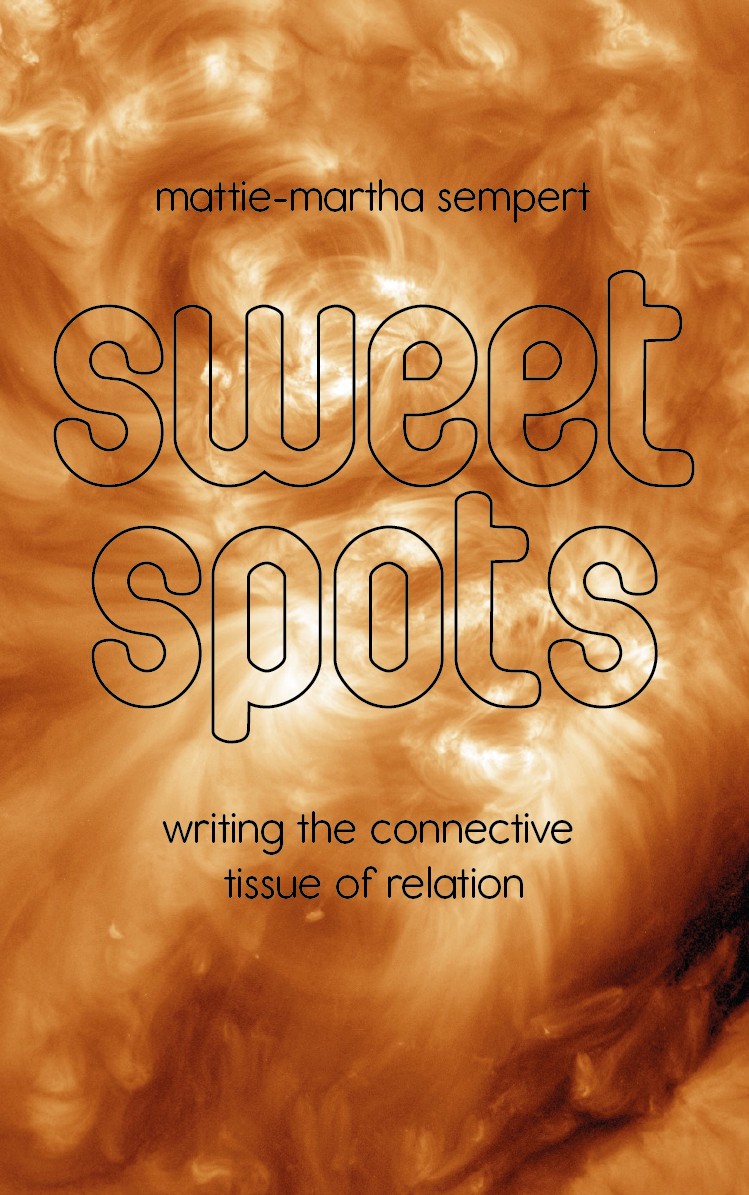
| Title | Sweet Spots |
|---|---|
| Subtitle | Writing the Connective Tissue of Relation |
| Contributor | Mattie-Martha Sempert(opens in new tab)(author) |
| DOI | https://doi.org/10.53288/0340.1.00(opens in new tab) |
| Landing page | https://punctumbooks.com/titles/sweet-spots-writing-the-connective-tissue-of-relation/(opens in new tab) |
| License | https://creativecommons.org/licenses/by-nc-sa/4.0/(opens in new tab) |
| Copyright | Sempert, Mattie-Martha |
| Publisher | punctum books |
| Publication place | Earth, Milky Way |
| Published on | 2021-12-30 |
| ISBN | 978-1-68571-010-1 (Paperback) |
| 978-1-68571-011-8 (PDF) | |
| Long abstract | Sweet Spots thinks transversally across language and body, and between text and tissue. This assemblage of essays collectively proposes that words—that is, language that lands as written text—are more-than-human material. And, these materials, composed of forces and flows and tendencies, are capable of generating text-flesh that grows into a thinking in the making. The practice of acupuncture—and its relational thinking—often makes its presence felt to twirl the text-tissue of the bodying essays. Ficto-critical thinking is threaded throughout to activate concepts from process philosophy and use the work of other thinkers (William James, Félix Guattari and Gilles Deleuze, Baruch Spinoza, and Virginia Woolf, to name a few) to forge imaginative connections. Entangled in the text-tissue are an assortment of entities, such as bickering body parts, quivering jellyfish, heart pacemaker cells, a narwhal tooth, Taoist parables, always with ubiquitous, stretchy connective tissue—from gooey interstitial fluid to thick planes of fascia—ever present to ensure that the essaying bodies become, what Alfred North Whitehead calls the* one-which-includes-the-many-includes-the-one.* The essaying bodies orient towards the sweetest sweet spot which is found, not in the center, but slightly askew, felt in the reverbing more-than that carries their potential. Crucially, this produces a shift in perspective away from self-enclosed bodies and experts toward a care for the connective tissue of relation. |
| Print length | 264 pages |
| Language | English (Original) |
| Dimensions | 127 x 203 mm | 5" x 8" (Paperback) |
| LCCN | 2021948743 |
| THEMA |
|
| BIC |
|
| BISAC |
|
| Keywords |
|
Contributors
Mattie-Martha Sempert
(author)Mattie-Martha Sempert is a practicing acupuncturist and creative writer and has a creative practice-led PhD from Royal Melbourne Institute of Technology. Her work has appeared in New Writing, Writing in Practice, Axon: Creative Exploration, The Lantern, Unlikely, and Immediation. Mattie is loosely planted in the bushland hills outside of Melbourne, where she attempts to make a daily habit living in William James’s World of Pure Experience.