
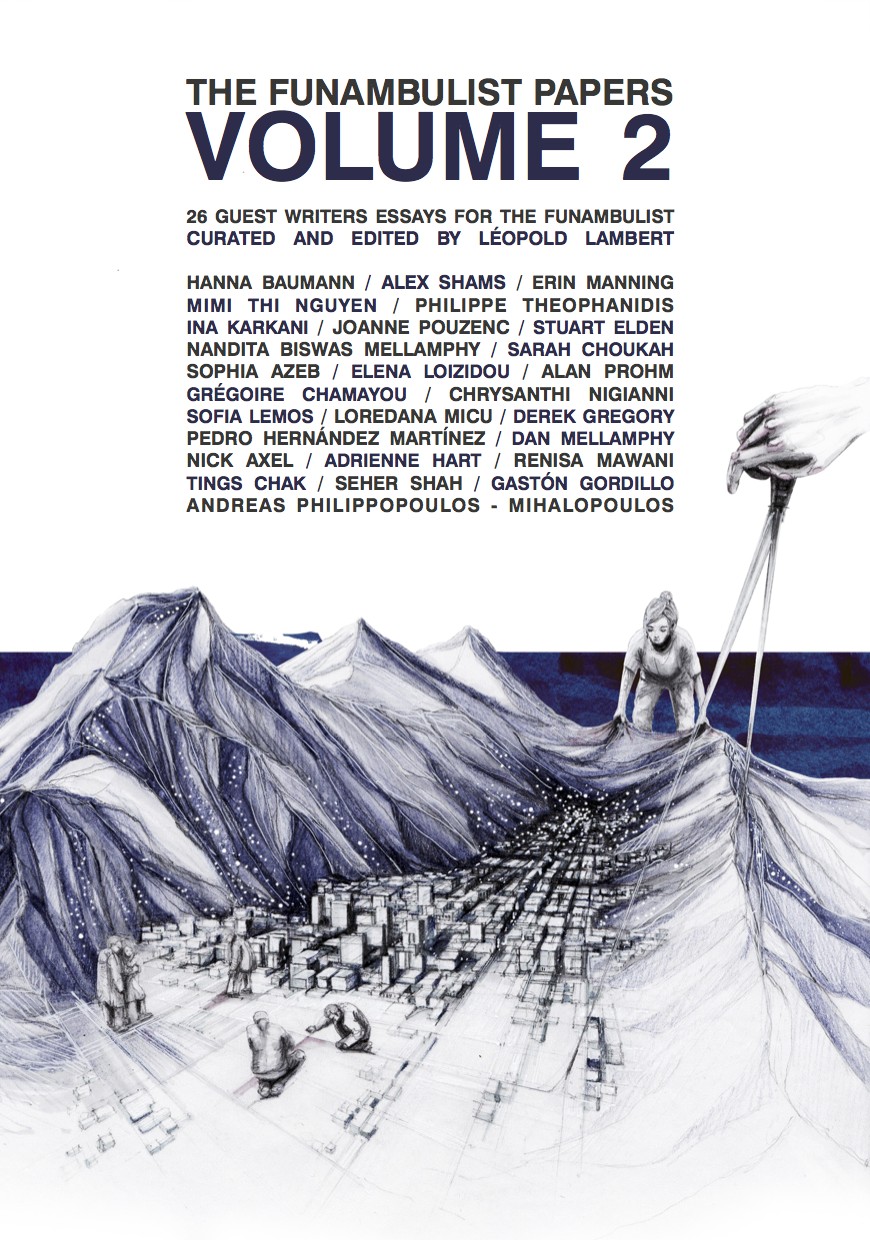
| Title | The Funambulist Papers, Volume 2 |
|---|---|
| Contributor | Léopold Lambert (editor) |
| DOI | https://doi.org/10.21983/P3.0098.1.00(opens in new tab) |
| Landing page | https://punctumbooks.com/titles/the-funambulist-papers-vol-2/(opens in new tab) |
| License | https://creativecommons.org/licenses/by-nc-sa/4.0/(opens in new tab) |
| Copyright | Lambert, Léopold |
| Publisher | punctum books |
| Publication place | Brooklyn, NY |
| Published on | 2015-04-09 |
| Book set | This book is part of a 2-volume set. The other volume in the set is: |
| ISBN | 978-0-692-42324-0 (Paperback) |
| Long abstract | This book is the second volume of texts curated specifically for The Funambulist(opens in new tab) since 2011. The editorial line of this second series of twenty-six essays is dedicated to philosophical and political questions about bodies. This choice is informed by Léopold Lambert’s own interest in the (often violent) relation between the designed environment and bodies. Corporeal politics do not exist in a void of objects, buildings and cities; on the contrary, they operate through the continuous material encounters between living and non-living bodies. Several texts proposed in this volume examine various forms of corporeal violence (racism, gender-based violence, etc.). This examination, however, can only exist in the integration of the designed environment’s conditioning of this violence. As Mimi Thi Nguyen argues in the conclusion of this book’s first chapter, “the process of attending to the body — unhooded, unveiled, unclothed — cannot be the solution to racism, because that body is always already an abstraction, an effect of law and its violence.” Although the readers won’t find indications about the disciplinary background of the contributors — the “witty” self-descriptions at the end of the book being preferred to academic resumés — the content of the texts will certainly attest to the broad imaginaries at work throughout this volume. Dialogues between dancers and geographers, between artists and biohackers, between architects and philosophers, and so forth, provide the richness of this volume through difference rather than similarity. The Funambulist Papers are published by the CTM Documents Initiative imprint, Center for Transformative Media(opens in new tab), Parsons School of Design, The New School. CTM is a transdisciplinary media research initiative bridging design and the social sciences, and dedicated to the exploration of the transformative potential of emerging technologies upon the foundational practices of everyday life across a range of settings. |
| Print length | 246 pages |
| Language | English (Original) |
| Dimensions | 148 x 210 mm | 5.83" x 8.27" (Paperback) |
| THEMA |
|
| BIC |
|
| BISAC |
|
| Keywords |
|
Contents
- Léopold Lambert
- Mimi Thi Nguyen
- Philippe Theophanidis
- Hanna Baumann
- Sophia Azeb
- Derek Gregory
- Stuart Elden
- Gastón Gordillo
- Pedro Hernández Martínez
- Tings Chak
- Alex Shams
- Sofia Lemos
- Grégoire Chamayou
- Renisa Mawani
- Nick Axel
- Sarah Choukah
- Andreas Philippopoulos-Mihalopoulos
- Erin Manning
- Adrienne Hart
- Elena Loizidou
- Joanne Pouzenc
- Chrysanthi Nigianni
- Ina Karkani
- Alan Prohm
- Dan Mellamphy
- Nandita Biswas Mellamphy
- Seher Shah
Contributors
Léopold Lambert
(editor)Léopold Lambert (born in 1985) is a French architect who has successively lived in Paris, Hong Kong, Mumbai, and New York, and currently resides in Paris. His approach to architecture consists in a delicate articulation between theoretical research and a frank enthusiasm for design. Such an articulation has been explicated in his book Weaponized Architecture: The Impossibility of Innocence(opens in new tab) (dpr-barcelona, 2012), which attempts to examine the characteristics that make architecture an inherent political weapon through global research as well as an architectural project specific to the Israeli civil and military occupation of the West Bank. He is also the author of the graphic novel, Lost in the Line(opens in new tab). He finds his architectural inspiration from films, novels, and political philosophy books, rather than in architectural theory texts.