
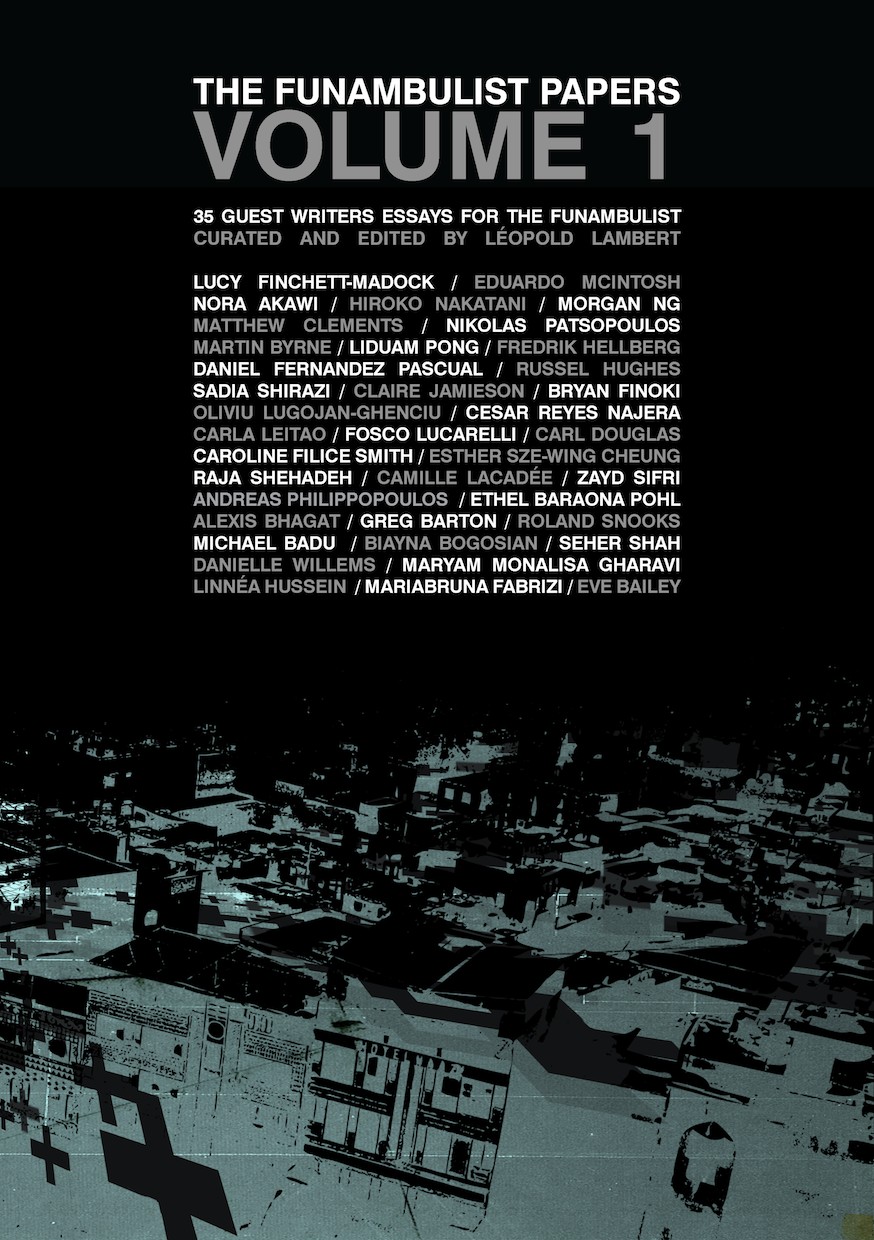
| Title | The Funambulist Papers, Volume 1 |
|---|---|
| Contributor | Léopold Lambert (editor) |
| DOI | https://doi.org/10.21983/P3.0053.1.00(opens in new tab) |
| Landing page | https://punctumbooks.com/titles/the-funambulist-papers-vol-1/(opens in new tab) |
| License | https://creativecommons.org/licenses/by-nc-sa/3.0/(opens in new tab) |
| Copyright | Lambert, Léopold |
| Publisher | punctum books |
| Publication place | Brooklyn, NY |
| Published on | 2013-10-23 |
| Book set | This book is part of a 2-volume set. The other volume in the set is: |
| ISBN | 978-0-615-89718-9 (Paperback) |
| Long abstract | This book is a collection of thirty-five texts from the first series of guest writers’ essays, written specifically for The Funambulist(opens in new tab) weblog from June 2011 to November 2012. The idea of complementing Lambert’s own texts on his blog with those written by others originated from the idea that having friends communicate with each other about their work could help develop mutual interests and provide a platform to address an audience. Thirty-nine authors of twenty-three nationalities were given the opportunity to write essays about a part of their work that might fit with the blog’s editorial line. Overall, two ‘families’ of texts emerged, collected in two distinct parts in this volume. The first part, The Power of the Line, explores the legal, geographical and historical politics of various places of the world. The second part, Architectural Narratives, approaches architecture in a mix of things that were once called philosophy, literature and art. This dichotomy represents the blog’s editorial line and can be reconciled by the obsession of approaching architecture without care for the limits of a given discipline. This method, rather than adopting the contemporary architect’s syndrome that consists in talking about everything but being an expert in nothing, attempts to consider architecture as something embedded within (geo)political, cultural, social, historical, biological, and dromological mechanisms that widely exceed what is traditionally understood as the limits of its expertise. |
| Print length | 210 pages |
| Language | English (Original) |
| Dimensions | 127 x 203 mm | 5" x 8" (Paperback) |
| THEMA |
|
| BIC |
|
| BISAC |
|
| Keywords |
|
Contents
- Léopold Lambert
- Lucy Finchett-Madock
- Daniel Fernández Pascual
- Ethel Baraona Pohl
- Cesar Reyes
- Michael Badu
- Mariabruna Fabrizi
- Fosco Lucarelli
- Caroline Filice Smith
- Greg Barton
- Maryam Monalisa Gharavi
- Nikolas Patsopoulos
- Zayd Sifri
- Liduam Pong
- Raja Shehadeh
- Sadia Shirazi
- Bryan Finoki
- Morgan Ng
- Nora Akawi
- Andreas Philippopoulos-Mihalopoulos
- Matthew Clements
- Hiroko Nakatani
- Fredrik Hellberg
- Linnéa Hussein
- Danielle Willems
- Carl Douglas
- Martin Byrne
- Claire Jamieson
- Carla Leitão
- Eduardo McIntosh
- Oliviu Lugojan-Ghenciu
- Roland Snooks
- Biayna Bogosian
- Esther Sze-Wing Cheung
- Russel Hughes
- Alexis Bhagat
- Eve Bailey
- Camille Lacadée
Contributors
Léopold Lambert
(editor)Léopold Lambert (born in 1985) is a French architect who successively lived in Paris, Hong Kong, and Mumbai and currently resides in New York. His approach to architecture consists in a delicate articulation between theoretical research and a frank enthusiasm for design. Such an articulation has been explicated in his book Weaponized Architecture: The Impossibility of Innocence(opens in new tab) (dpr-barcelona, 2012), which attempts to examine the characteristics that make architecture an inherent political weapon through global research as well as an architectural project specific to the Israeli civil and military occupation of the West Bank. He is also the author of the graphic novel, Lost in the Line(opens in new tab). He finds his architectural inspiration from films, novels, and political philosophy books, rather than in architectural theory texts. He is currently collaborating with Madeline Gins for her Reversible Destiny Foundation(opens in new tab) (created with the late Arakawa) whose philosophical and architectural work is highly influential upon the role of architecture in relation to the human body.